 Live Music Archive
 Librivox Free Audio
 Metropolitan Museum
 Cleveland Museum of Art
 Internet Arcade
 Console Living Room
 Books to Borrow
 Open Library
 TV News
 Understanding 9/11
The Hutch Living History Project
Audio With External Links Item Preview
- Usage
- Public Domain


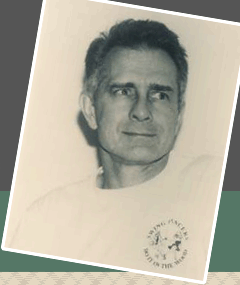
Craig Hutchinson taught and studied vernacular partner dancing for almost 40 years. He was elected to the World Swing Dance Council Hall of Fame in 1993. Craig was a retired Lieutenant Colonel from the U.S. Army Corps of Engineers, holding a Mineral Engineer-Mathematics degree from the Colorado School of Mines and a Masters' Degree in Mathematics from the University of Arizona.
He was first exposed to West Coast Swing in 1960 in Colorado by Carter Lovisoni, and began teaching in the 1960s. He joined the military in the late 1960s, and, while with the Army, visited major population centers and ballroom dance competitions around the United States, Europe, and Asia in the mid-to-late 20th Century. He noticed unique styles in social dance wherever he went, but he noted commonalities between dance styles.
He formed the United States Military Academy Swing Dance Club at West Point, N.Y. in 1975 and developed a West Coast Swing syllabus. His dance teams won competitions, and, as a result, he gained a measure of celebrity, appearing on game shows (What's My Line?, To Tell The Truth) in the 1970s.
Hutch, upon settling in Falls Church, Va. in the 1980s, formed the Potomac Swing Dance Club out of his basement. He loosely based his club on the structure of Carolina Shag clubs in the southeast United States. His PSDC dances were held in several places in northern Virginia, but settled at the Vienna Grille and Tap Room on Maple Avenue in Vienna, Va.
He kept a schedule of hosting dances and teaching classes that would wear down an ordinary man. Hutch scheduled his home lessons — at five bucks a head, 25 for a private lesson, an utter bargain – to cover everything from footwork fundamentals to the best arm positions for a spin.
He was also a true multi-tasker. He kept the cash register at PSDC dances, taught relentlessly, promoted his own dances and those of others, and wrote his newsletter, punctuated with this introduction: "Craig R. Hutchinson: Publisher, Editor, Art Director, Columnist, Data Entry Clerk, Bookkeeper, Telephone Operator, Stamp Licker, Collator, Paper Folder, Complaint Manager, Dance Teacher, DJ, Janitor and Chief Go-Fer."
The newsletter also included a monthly rhythm break which would be absolute gibberish if you didn't read his book, "Swing Dancer: A Swing Dancer's Manual." This publication took his knowledge of engineering and mathematics to create what appear to be dance functions. Upon breaking down dance steps, he noted a universality between swing dance genres.
Hutch tested his theories by teaching many different kinds of vernacular dance, inviting teachers and performers from all over the nation, and getting different people to come together for dances and competitions, such as co-promoted dances between two or more dance communities.
He started the Virginia State Open as a way to get many different styles of dance into the same competition, and even into the same event. Like a trophy dash at the end of a night of dirt-track automobile racing, the VSO would get the category winners of the night's events in a four-song danceoff to determine an overall champion in both the showcase (lifts allowed) and the classic (no lifts allowed) divisions.
Hutch's influence in the D.C. vernacular dance community cannot be measured. He showed that, by providing a safe, clean place to dance and socialize, dance communities can form around not only a particular style of dance, but around a particular place. Numerous dance promotions dot Maryland, Virginia, and the District of Columbia, thanks to Hutch.
In late 2004, Craig Hutchinson contracted contracted cortico basilar ganglionic degeneration, a disease which tears down the body’s ability to move -- a terrible fate for someone who studied dance and mechanics of the body. In early 2005 over the course of about three weeks, interviews were conducted for The Hutch Living History Project.
The interviews were convened by Al Mattei, a social dancer, journalist, and dance volunteer. Sitting in on some of these tracks are Ken Roesel (dancebuddies.com), a top West Coast Swing teacher; Donna Barker (dancedc.com), a long-time organizer and teacher of swing, jitterbug, tango, and waltz; Jeff Booth (thejamcellar.com), a swing dance teacher and part-time swing historian; and David Rehm (davidrehm.com), a swing enthusiast, Balboa teacher and part-time swing historian. You might also hear the voice of Craig's wife, Lucy Renzi, in the background.
The interviews were recorded on Sony MiniDisc through a self-powered Sony condenser microphone perched on an inverted wine glass. As such, some vibrations can be heard throughout these recordings. The recordings were digitized using the Audacity open-source computer program for Macintosh OS X.
He was first exposed to West Coast Swing in 1960 in Colorado by Carter Lovisoni, and began teaching in the 1960s. He joined the military in the late 1960s, and, while with the Army, visited major population centers and ballroom dance competitions around the United States, Europe, and Asia in the mid-to-late 20th Century. He noticed unique styles in social dance wherever he went, but he noted commonalities between dance styles.
He formed the United States Military Academy Swing Dance Club at West Point, N.Y. in 1975 and developed a West Coast Swing syllabus. His dance teams won competitions, and, as a result, he gained a measure of celebrity, appearing on game shows (What's My Line?, To Tell The Truth) in the 1970s.
Hutch, upon settling in Falls Church, Va. in the 1980s, formed the Potomac Swing Dance Club out of his basement. He loosely based his club on the structure of Carolina Shag clubs in the southeast United States. His PSDC dances were held in several places in northern Virginia, but settled at the Vienna Grille and Tap Room on Maple Avenue in Vienna, Va.
He kept a schedule of hosting dances and teaching classes that would wear down an ordinary man. Hutch scheduled his home lessons — at five bucks a head, 25 for a private lesson, an utter bargain – to cover everything from footwork fundamentals to the best arm positions for a spin.
He was also a true multi-tasker. He kept the cash register at PSDC dances, taught relentlessly, promoted his own dances and those of others, and wrote his newsletter, punctuated with this introduction: "Craig R. Hutchinson: Publisher, Editor, Art Director, Columnist, Data Entry Clerk, Bookkeeper, Telephone Operator, Stamp Licker, Collator, Paper Folder, Complaint Manager, Dance Teacher, DJ, Janitor and Chief Go-Fer."
The newsletter also included a monthly rhythm break which would be absolute gibberish if you didn't read his book, "Swing Dancer: A Swing Dancer's Manual." This publication took his knowledge of engineering and mathematics to create what appear to be dance functions. Upon breaking down dance steps, he noted a universality between swing dance genres.
Hutch tested his theories by teaching many different kinds of vernacular dance, inviting teachers and performers from all over the nation, and getting different people to come together for dances and competitions, such as co-promoted dances between two or more dance communities.
He started the Virginia State Open as a way to get many different styles of dance into the same competition, and even into the same event. Like a trophy dash at the end of a night of dirt-track automobile racing, the VSO would get the category winners of the night's events in a four-song danceoff to determine an overall champion in both the showcase (lifts allowed) and the classic (no lifts allowed) divisions.
Hutch's influence in the D.C. vernacular dance community cannot be measured. He showed that, by providing a safe, clean place to dance and socialize, dance communities can form around not only a particular style of dance, but around a particular place. Numerous dance promotions dot Maryland, Virginia, and the District of Columbia, thanks to Hutch.
In late 2004, Craig Hutchinson contracted contracted cortico basilar ganglionic degeneration, a disease which tears down the body’s ability to move -- a terrible fate for someone who studied dance and mechanics of the body. In early 2005 over the course of about three weeks, interviews were conducted for The Hutch Living History Project.
The interviews were convened by Al Mattei, a social dancer, journalist, and dance volunteer. Sitting in on some of these tracks are Ken Roesel (dancebuddies.com), a top West Coast Swing teacher; Donna Barker (dancedc.com), a long-time organizer and teacher of swing, jitterbug, tango, and waltz; Jeff Booth (thejamcellar.com), a swing dance teacher and part-time swing historian; and David Rehm (davidrehm.com), a swing enthusiast, Balboa teacher and part-time swing historian. You might also hear the voice of Craig's wife, Lucy Renzi, in the background.
The interviews were recorded on Sony MiniDisc through a self-powered Sony condenser microphone perched on an inverted wine glass. As such, some vibrations can be heard throughout these recordings. The recordings were digitized using the Audacity open-source computer program for Macintosh OS X.
Reviews
There are no reviews yet. Be the first one to
write a review.
1,586 Views
IN COLLECTIONS
Cratediggers Folksoundomy: A Library of Sound
Uploaded by TopOfTheCircle on


